Release Notes for 2026.1.3 Release - May 20, 2026
New Features & Improvements
Local Timezone Display for IDE Activity Timestamps: Last IDE activity timestamps are now displayed in the user's local time zone rather than UTC in the CodeTogether Portal, making it easier to interpret developer activity without manual timezone conversion.
Add Team Members Without Issue Tracker Activity: It is now possible to manually add team members to a connected project even if they have no activity in the linked issue tracker. This addresses a gap for roles such as project managers and engagement managers who contribute to a project but do not hold Jira tickets. Members added this way are protected from being removed during periodic issue tracker syncing, ensuring stable project membership regardless of issue tracker activity
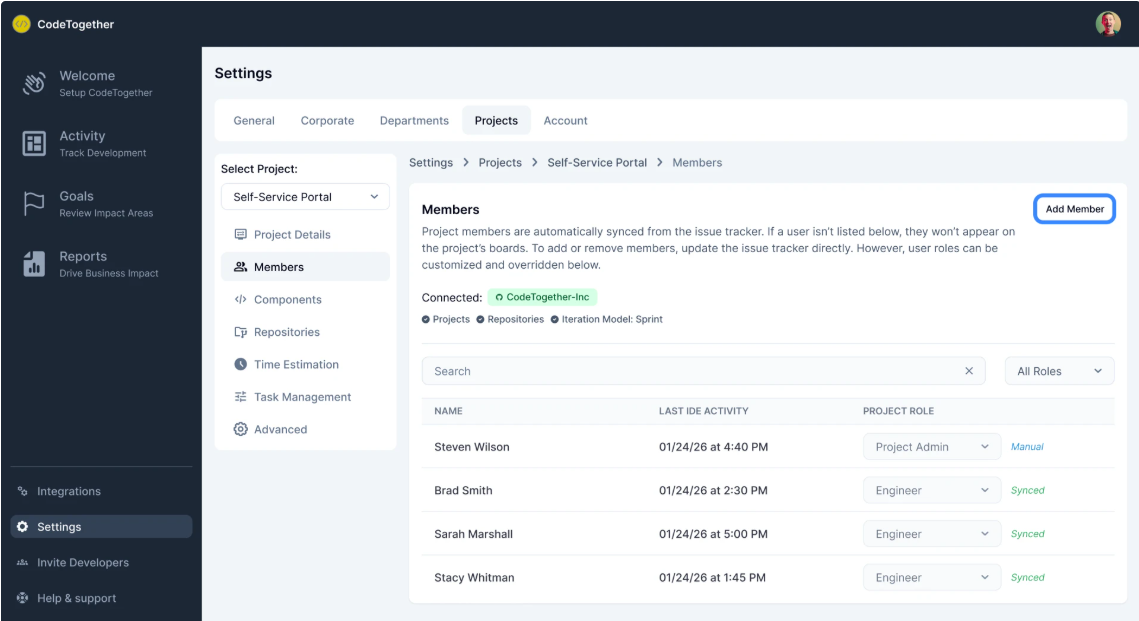
Remove Synced Project Members: Administrators can now manually remove synced project members directly from the portal. Previously, only manually-added members could be removed - members synced from an issue tracker could not be excluded when teams were structured across multiple boards within a single Jira space. Once removed, a member will not be re-added by subsequent external syncs; they can only be restored through a manual add.
Improved Developer Tracking for Forked Repositories: Developers working on forked repositories are now correctly tracked and associated with the parent project. Previously, a mismatch between the fork's remote origin and the upstream project URL could cause activity to appear inactive and prevented Active status from registering in the IDE. This has been resolved.
Automatic User Merging Based on Local Commit Author: When a local commit is uploaded with an email address that does not match the uploader's account, CodeTogether now automatically associates the new email with the correct user and links the commit - without waiting for the next periodic sync. This reduces duplicate user records and improves data consistency for administrators.
Secondary Email Domain Support for IDE Plugin: The IDE plugin now supports secondary email domains, addressing cases where developers use a different email domain in their Git configuration than the one associated with their CodeTogether account. This improves automatic user matching and reduces the need for manual intervention when teams use multiple email domains.
Highest Role Permissions Now Correctly Honored: When a user is assigned roles at multiple levels (Corporate, Department, and Project), the platform now correctly preserves the highest-level role granted. Previously, adding a more restrictive role at a lower level could inadvertently narrow the effective permissions applied. The most permissive role across all levels is now consistently applied.
Project Admins Can Now Edit Time Estimation: Project Admins now have full access to edit time estimation settings on connected projects, consistent with their role permissions.
Cleaner Effort Display When Time Effort Is Unavailable: The platform previously showed a default of “.2 Eng Days” when effort data could only be inferred from repository activity. This inferred value was a source of confusion and has been removed. When time effort is not available, the field now shows no value.
Refined Stalled Task Insight Threshold: The Stalled Task insight now applies a time-bounded threshold to reduce noise from abandoned work. An insight is only surfaced when all of the following conditions are met:
- At least 30 minutes of activity has been tracked on the task
- The task has not yet reached the In Review stage
- Last activity was more than 2 days ago
- Last activity was no more than 7 days ago Tasks inactive for longer than 7 days are no longer flagged as stalled, providing a more actionable and focused view of work that is genuinely at risk.
Improved Accuracy of Rolled-Up Metrics: Metric rollup calculations now exclude statistical outliers, preventing extreme edge cases (such as a single task with unusually high code churn) from skewing team-level averages. This improves the reliability and interpretability of aggregated metrics across projects and departments.
Performance Improvements for Large Repositories: A series of optimizations have been made to improve responsiveness and resource efficiency, particularly for large or complex repositories:
Optimized secondary ID calculation: Git tags are now excluded when computing secondary repository IDs, improving performance and reducing resource usage for repositories with extensive tag histories. Commit objects are also released after reading to further reduce memory footprint.
Large file handling improvements: Diff computation is now skipped for files larger than 512 kB, improving processing efficiency during code analysis.
Improved repository resource management: Repository lifecycle handling has been refined to ensure resources are released promptly and consistently.
Reduced daemon thread usage: The daemon now uses fewer background threads, lowering baseline resource consumption.
Increased daemon memory allocation: The memory allocation for the daemon process has been increased to 128 MB to better support workloads on larger codebases.
Proactive repository cleanup under load: The daemon now performs proactive repository cleanup when resource thresholds are approached, ensuring consistent performance under heavier workloads.
Bug Fixes
CodeTogether Plugin No Longer Blocks “Go to Declaration” in IntelliJ 2026.1: Resolved a compatibility issue between the CodeTogether plugin and IntelliJ IDEA 2026.1 that prevented Java navigation from working correctly. Users were unable to navigate to declarations using Ctrl+B, Cmd+B, or F3. Navigation now works as expected with the plugin installed.
Resolved Issue Sync Error: Fixed an issue that could cause issue syncing to fail for projects connected to Jira when specific changelog entries were encountered during processing. Affected projects now sync reliably.
Repository-Level Email Config Now Applied During User Auto-Merge: Fixed an issue where email addresses defined in a repository's local Git config were not being applied during automatic user merging on project creation. The correct email is now populated from repo-level Git configuration, improving attribution accuracy from the start.
Security: Resolved HIGH Severity Vulnerabilities: Upgraded the jackson-core dependency to address a HIGH severity vulnerability (GHSA-72hv-8253-57qq) identified in the codetogether-intel image. No critical vulnerabilities were present; this update further strengthens the platform’s security posture.